

THE DISEASE
VED Eye is a pioneer in Cataract treatment. We have a track record of successfully performing the most complicated Cataract surgeries. The cataract team is headed by Dr. Manish Raval(M.S.) PHACO & LASIK SURGEON, who is recognized globally as the leading surgeon in the field of cataract surgery. He has won national level awards at various conference for best pediatric cataract management. He is a member of europeon society of cataract and refractive surgery.he has carried out live surgeries at many teaching institute.
Our team of cataract experts at VED Eye has innovated various techniques for cataract surgery that are adopted and followed by surgeons all over the world. We take pride in using the latest and best diagnostic and surgical technology and international standard operating rooms. Based on an exhaustive diagnostic workup, we provide our patients with many intraocular lens (IOL) options including multifocal and toric IOLs and help them choose the best option based on their individual lifestyle requirements and their overall eye condition. At VED Eye, patient safety is our prime concern and therefore we use single use disposable and US FDA approved products before, during and after the surgery.
Due to our expertise in cataract treatment, we have now become a world class referral centre for many complicated types of cataract, including hard cataracts, subluxated cataracts, white mature cataracts, posterior polar cataracts and cataracts in children.
AT OUR SETUP
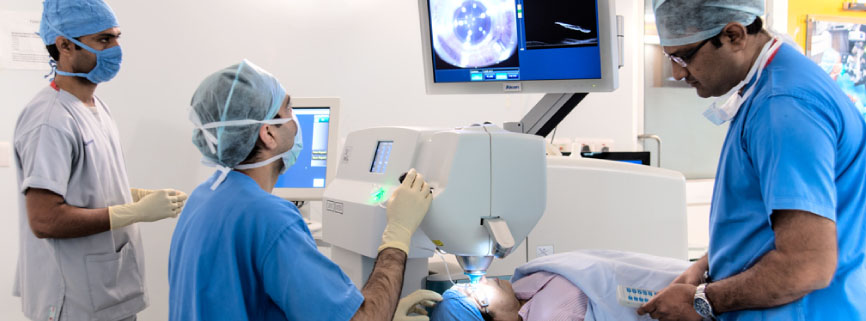
The surgery is performed on an outpatient basis. Prior to the surgery a comprehensive eye examination is conducted to check the overall health of the eye and determine the eligibility for the surgery. This diagnosis also allows the surgeon to decide the proper power of the IOL lens to be implanted. The surgical coordinator will help in deciding the type of surgery best suited to enhance the vision.
PHACOEMULSIFICATION
An incision is created manually to open the outer covering of the lens. Thereafter, a small instrument called the phaco probe is introduced within
the eye. Ultrasound vibrations are used to break the cataract into small pieces (emulsification), which are then removed using a suction device
through the same probe. Thereafter, a foldable intraocular lens is implanted in the eye.
TYPES OF INTRAOCULAR LENSES(IOLS)
A range of IOLs, including monofocal IOLs, multifocal IOLs, toric IOLs, and trifocal IOLs are available. These are all designed to enhance your lifestyle and reduce dependence on glasses following the cataract surgery.
Cataract surgery does not require any modifications in your lifestyle or working patterns. It is a daycare procedure and patients can resume their normal activities immediately after surgery.
There are no lifestyle restrictions or hospitalization required for cataract surgery.
FAQ
Cataracts occur when there is a buildup of protein in the lens that makes it cloudy. This prevents light from passing clearly through the lens, causing some loss of vision. As the cataract advances the cloudiness in the eye also increases until it is treated.
A cataract is a part of ageing process. It is the most common cause of vision loss in people over age of 50. The amount and pattern of cloudiness can vary within the lens.Moreover cataract can develop cause of eye injury, presence of diabetes and usage of some medications or any other eye diseases. It is not necessary for cataract to develop only in old age only but it does develop in infants as well.
Cataracts usually form slowly and cause few symptoms until they noticeably block light. Symptoms may vary from individual to individual, some people may have problem with vision that is cloudy, blurry, foggy. Some may experience progressive nearsightedness in older people often called “second sight” because they may no longer need reading glasses. There might be changes in the way you see color because the discolored lens acts as a filter. You may face problems driving at night such as glare from oncoming headlights, problems with glare during the day, double vision (like a superimposed image).
As cataract is a part of ageing process it cannot be prevented. Using your eyes and your involvement in your daily activities has nothing to do with cataract formation. There are no current medicines as per the ongoing researches that have been proven to be helpful in the treatment of cataracts. The only known treatment for cataract is surgery.
When the cataract advances to a level which causes blurred vision, interfere with activities of daily living, or prevent them from leading active and productive lives, in such cases, these individuals should not wait to undergo surgery to remove their cataracts
The lens choice is customized to suit the patient and depends on their overall eye condition including their optical system and considering the visual needs of the patient. Modern lenses are able to increase range of focus to include both distance and near vision.
We offer Aspheric monofocal (IQ), multi-focal (RESTOR), cylindrical (TORIC) and multi-focal combined cylindrical (RESTOR-TORIC)
IQ – is a Monofocal foldable IOL with thinner aspheric design for improved image quality , blue light filtration for uncompromised colour perception and single – piece acrylic design for superior biocompatibility and stability.
ReSTOR Aspheric – is a Multifocal acrylic foldable IOL which is the most frequently implanted Presbyopia correcting IOL with more than a quarter million implantations worldwide , has patented Apodised technology to minimize visual disturbances and has an aspheric optic to improve image quality and functional vision.
Toric IOL – is an astigmatism correcting Monofocal acrylic foldable IOL which is rotationally stable in the eye. The power of IOL is calculated using the AcrySofToric Calculator which ensures precise astigmatic correction.
RestorToric IOL- This IOL incorporates a promising new technology where the same IOL corrects astigmatism and also corrects presbyopia.It combines the benefits of a multifocal and Toric IOL.
Our team of doctors and counselors would be pleased to educate you for the best suitable option
The ophthalmic surgeon decides whether the patient can undergo phaco or not.The medical team will do a detailed eye examination to check the type of cataract, eye pressures, retina etc. to rule out any other eye problem. A Scan or Intraocular lens power calculation test will be done to know what power lens should be implanted after cataract removal.On the finding of the test it is been decided whether the patient is eligible for it or not and if not then which treatment he is eligible and suitable for.
IOL power calculations are done by trained professionals and every effort is made so as to get very minimal post-operative power in the distance glasses. This is done using immersion ultrasound biometry for measuring the eye accurately prior the surgery. A new device called the IOLMaster is available at the centre which is capable of extremely accurate measurement of the eye and calculation of the IOL power.
Once the IOL is implanted in the eye, it remains in place for the remainder of one’s lifetime.
Complications are rare and similar ones can occur with conventional surgery without an IOL implantation. Today, the technological advances in IOL manufacture and surgery have made it very much safe. All patients irrespective of other general illnesses like diabetes, hypertension etc. can have IOL surgery.
Cataract surgery is a highly successful procedure (95-98% success rate) technically. However, the final visual outcome also depends on the condition of the eye i.e. cornea, retina, optic nerve, any pre-existing disease, amblyopia (lazy eye) etc. Sometimes it may be difficult to diagnose these abnormalities before the surgery due to cataract and we can know about it only after the operation. No surgeon in the world can perform a surgery with guaranteed results. However, almost all the patients regain good vision following a cataract surgery.
In spite of the best care and precautions, like any other surgical procedure in the human body, there is a possibility of minor to major complication.
Some minor complications like slight drooping of the eyelid, swelling around the eye, corneal haze, reflection or slight distortion from lens implant, delayed healing, corneal edema are temporary and recover with time and medication. The chances of a serious complication like infection, severe inflammation, retinal detachment, nucleus drop, hemorrhage are negligible.
In a majority of cases these complications can be treated successfully or may resolve on their own with a good final restoration of vision. Since all the complications cannot be listed, the above list is not exhaustive.
In case of few patients undergoing cataract surgery, the back part of the lens capsule may thicken over a period of time causing blurred vision. This is known as Posterior Capsular Opacification (PCO), secondary cataract or “After Cataract”. This is not a complication. The condition is treated with a “YAG Laser Capsulotomy” with full restoration of vision.


